

Overview
Deep venous thrombosis (DVT) refers to the formation of a blood clot in the deep venous system, a network of large veins with extensive branching that covers the whole body.
The most common site for deep venous thrombosis is in the deep veins of the legs and thighs. This is, in part, explained by the “pooling” of blood in a person’s leg veins due to gravity, especially during periods of prolonged immobilisation such as long distance travelling, hospitalisation or after major surgery. For this reason, the condition is sometimes known as the “economy-class syndrome”
Why have I developed a DVT?
Risk Factors
Any one may be at risk for DVT, but the presence of the following risk factors can increase one’s chance of developing DVT.
- Hospitalisation for a medical illness
- Recent major surgery or injury
- Previous history of DVT
- Known personal history or a family history of a clotting disorder
- History of active cancer and concurrent cancer therapy
- Pregnancy and first 6 weeks after delivery
- Smoking
- Hormone replacement therapy or high dose combined oral contraceptive pill
- Being overweight or obese
- Prolonged sitting (greater than 6 to 8 hours)
Sometimes people develop blood clots for no apparent reason. These are often called spontaneous DVT.
Symptoms, Diagnosis & Additional Complications
What are the Symptoms and Signs of a DVT?
Pain and swelling are usually the main symptoms of a below knee DVT. Sometimes the area around a blood clot can feel warmer than the surrounding tissues.
Deep Venous thrombosis and Pulmonary Embolus
DVT isolated in the leg veins can result in pain, skin inflammation and ulceration. However, if the clot breaks off and travels through the bloodstream into the lungs, it can seriously affect lung and heart functions. This condition is known as pulmonary embolus (PE). PE can be life-threatening and may result in death.
Diagnosis of DVT: How are blood clots detected?
The diagnosis of DVT based on symptoms alone can be difficult. A venous doppler ultrasound is frequently ordered to confirm the diagnosis. Ultrasound machines use sound waves to detect blood flow in veins and arteries. A clot can be detected because of the decreased blood flow in the veins. Ultrasound is painless and does not have any major side effects. Sometimes blood tests are also used to help in the detection of blood clots.
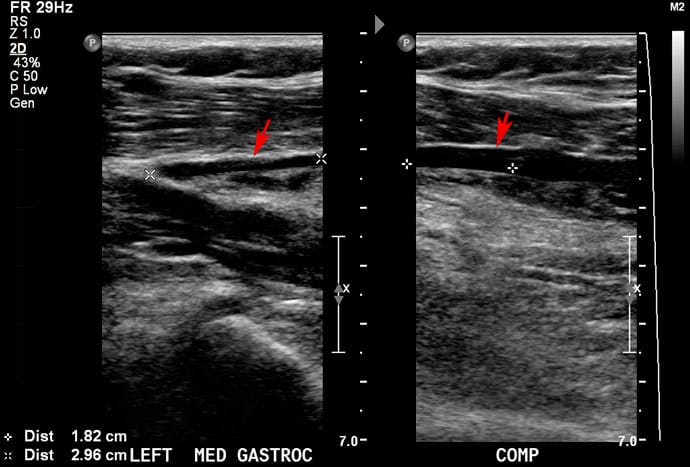
Ultrasound evaluation demonstrates the presence of a blood clot (deep vein thrombosis) in the leg. On the left, the vein (arrow) is compressed with the ultrasound probe and would normally collapse, however remains patent. On the right, the pressure is released and the same vein (arrow) containing the clot is more obvious.
[*Image courtesy Melbourne Radiology Clinic]
What are the main problems with DVT’s?
There are three main problems if a blood clot occurs in the deep veins.
Treatment & Management
What is the Treatment of DVT?
Most treatment for DVT can occur without hospitalisation – however hospitalisation may be necessary if there are extensive clots or there is a suspicion of pulmonary embolus.
Blood thinning (anticoagulation) is the main treatment for DVT and PE to prevent further blood clots. They can be in the form of an injection (e.g. Clexane) or tablets (e.g. warfarin). XXXX
In very serious cases, a medication to dissolve the blood clot can be used. There is a significant risk of bleeding with this medication and you should discuss this carefully with your doctor. This will require close monitoring in a hospital.
What can I do to prevent further DVT from occurring?
Maintaining a healthy lifestyle is important to reduce the risk of further DVT.
This includes:
- quit smoking
- maintain an ideal body weight
- regular exercise
- maintain adequate hydration and leg movement, especially during long distance travel
- selective use of compression stockings and low dose anticoagulant drugs in high-risk hospitalised patients.
in 5000 people has HS
people in Melbourne
population of Melbourne*
What does having HS mean?
There are three main common problems associated with having HS:
There is another uncommon potential problem for people who have Hereditary Spherocytosis associated with a viral infection called “Slapped cheek”. Slapped cheek is caused by a virus called Parvovirus which can infect bone marrow cells and put the red cell producing cells “to sleep”. Because patients with HS need the bone marrow to be rapidly replacing the fragile red cells, this infection can cause a severe anaemia; patients can become very pale and sometimes even require blood transfusions. Fortunately this problem is uncommon.
Diagnosis
How is Hereditary Spherocytosis diagnosed?
HS is now diagnosed with a simple blood test. It is also important for a doctor to examine patients with HS to see if they are jaundiced or have an increase in the size of the spleen.
Treatment & Management
What do I need to do now that I (or my child) has been diagnosed with Hereditary Spherocytosis?
Most patients with HS do not need to do much about their condition at all. The bone marrow has the capacity to increase the number of red cells it produces many fold and is able to keep up replacing the fragile cells.
A few things may be helpful:
Will I (or my child) need a splenectomy?
Removing the spleen (splenectomy) has been used a lot in the past in the treatment and management of patients with HS; it stops the red cells from breaking down and solves the problems of HS.
Removing the spleen has problems however – the spleen is an important organ in the immune system and patients who do not have a spleen may be prone to getting serious infections. This risk is higher in younger children but may be less than previously expected because of newer vaccinations. It is now generally recommended to avoid splenectomy in children younger than 6 years and to ensure that children who may need a splenectomy have all the appropriate vaccinations.
Another approach for some of these young patients is to remove only a small part of the spleen – partial splenectomy. This is done in a few hospitals and there is some experience to say this may be very helpful for some patients.
Resources
- Vascular Disease Foundation (http://vasculardisease.org/deep-vein-thrombosis-venous-disease/)
- Better Health Channel (www.betterhealth.vic.gov.au)
Further Questions?
The information presented in this fact sheet is intended as a general guide only.
Patients should seek further advice and information about Deep Venous Thrombosis (DVT) and their individual condition from their treating haematologist or doctor.